
Group
Huragok
Race of biological supercomputers that were created by the Forerunners
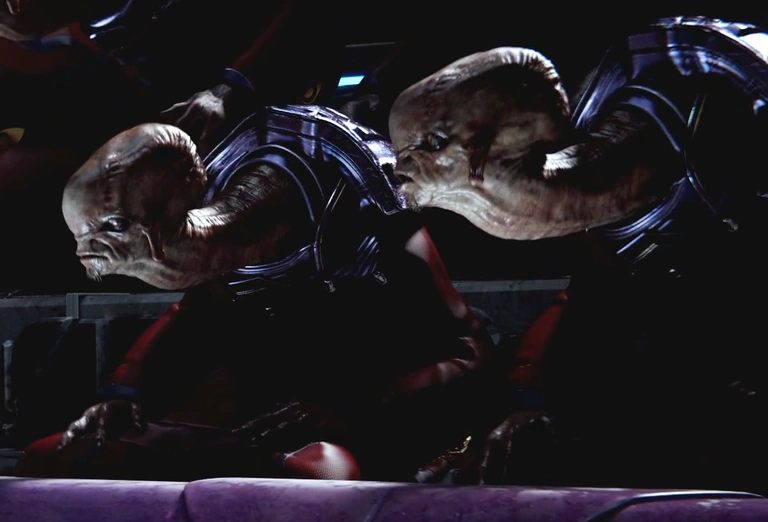
Huragok (Latin Facticius indoles, meaning "Man-made character" ), known to humans as Engineers, are a race of biological supercomputers that were created by the Forerunners. They are the only known non-combatant race to ever serve the Covenant, though some were rigged to explode as suicide bombers. After the Covenant's collapse, the Huragok serve the UNSC, other than those that fled or were captured by the San'Shyuum.
Description
While it is generally held that only the San'Shyuum were high enough in the Covenant Hierarchy to handle and manage Forerunner research and technology, in reality it was the Huragok who must excavate, unlock, and transport Forerunner artifacts (a fact only known to higher-ranked officers and leaders within the Covenant, due to its sensitive nature), though the San'Shyuum insist that any admission of that fact was heresy. These remarkably helpful and docile aliens are exceedingly patient, rarely communicate with other species, and are almost single-mindedly devoted to their work.
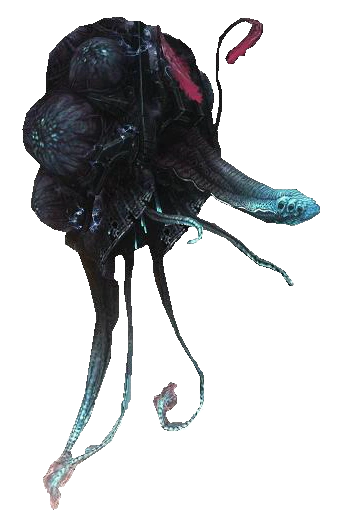
Huragok were the scientific and engineering backbone of the Covenant and its economy. They float via bladders that contain a mixture of lighter-than-air gases, and their four tentacles are able to split into many fine cilia, with which they are able to manipulate machinery on a near-microscopic level. Engineers are capable of quickly learning the functionality of new technology. On one occasion, an Engineer was observed by John-117 dismantling a vehicle's engine, assembling it into various other working configurations and then returning it to its original state in a matter of seconds. When the Covenant fell, the loss of Huragok made the replacement and repair of their technology extremely problematic.
Huragok have little interest in taking sides in conflict; they appear to draw no real distinction between friend and foe, and prefer to spend their time inspecting or repairing technology. However, they will utter a high-pitched keening sound whenever a Forerunner artifact is threatened. On occasion they may even push or strike an individual for interfering with Forerunner technology, most notably Catherine Halsey and Jul 'Mdama. They are apathetic to any sort of combat, and tend to just float along with a single goal: fixing things. In one encounter, a Huragok repaired John-117's damaged shield generator and then floated away; the unfortunate Huragok was later shot by Lieutenant Haverson to prevent it from possibly giving the specifications of the Spartan's improved shield technology to the Covenant. If shot at in a firefight, Huragok make no attempt to defend themselves, but rather curl up in fright and try to float to a safe distance.
Their concentration has been described as "a trance-like reverie" by the few who have witnessed it. They usually communicate only with San'Shyuum, a fact that may contribute to the balance of power between Sangheili and San'Shyuum, and will usually ignore anything that is neither a San'Shyuum, a Forerunner artifact, nor a machine. A notable exception is the Huragok Lighter Than Some, who communicated with the Unggoy Deacon Dadab via Huragok sign language.
The abilities of the Huragok are not limited to fixing things; they are also able to absorb data from a computer or an A.I., and combine it with their own biological "data." One such incident occurred when one Huragok combined its knowledge with the dumb AI of New Mombasa, the Superintendent. During a mission to recover a living Huragok, Captain Veronica Dare described the species as "biological supercomputers."
While they currently serve the UNSC, it is possible that the Arbiter reacquired them for the Sangheili, though unlikely as the Sangheili had no idea where the San'Shyuum had gone to. It can be assumed that Jul 'Mdama's Covenant do not possess them as they do not appear in Halo 4, Spartan Ops, or Halo 5: Guardians.
Origins
The Huragok were created by the Forerunners prior to the first activation of the Halo Array. They have been found to be living inside of Onyx's Dyson Sphere shield world for 100,000 years. It has been suggested that the Covenant found the Huragok first by infiltrating a separate Dyson Sphere. During the Harvest Campaign, the Covenant access a shield world, trying to exploit and steal all technology they have, including shields.
Anatomy and physiology
The Engineers are actually not a natural, biological species at all, but rather an artificial life form created by the Forerunners. While they possess no true tissues or organs, their nano-mechanical surrogates so closely mimic their biological analogs that they seem almost indistinguishable to observers. Multiple gas-bladders serve as their method of locomotion, allowing them to float through the air even after their deaths. The bladders also serve as part of their respiratory system; if their gas bladders deflate, they will asphyxiate and die.

They have small heads with six dark eyes, and four tentacles that can split into very small, near-microscopic cilia. The Engineers use these cilia to construct, repair, or rebuild nearly anything they can grasp. They can take apart whole vehicles and rearrange their entire structure in a matter of seconds, with the resulting machines still operating at least as well as they did before. They learn at an unprecedented rate, and store that information for future reference if ever they need to repair the same thing twice. They are capable of surviving in at least oxygen and methane-rich environments, though they cannot survive in a vacuum.
Huragok are not normally a tactical threat and are hardly ever seen in combat situations. Most UNSC soldiers make a point of avoiding intentionally harming Huragok if possible. Unlike the majority of the Covenant races, they do not regard humans as enemies; during the assault upon Ascendant Justice, one even aided the Spartan-II by repairing the shield generator on his MJOLNIR armor and fixing the Spartan's current weapon, a broken Needler. However, Lieutenant Haverson killed the Engineer stating that it had learned all about the MJOLNIR shield technology, which was superior to the Sangheili Personal Energy Shield, and could not be allowed to relay that information. In Halo: Contact Harvest, a Huragok named Lighter Than Some attempted to aid the Humans in an attempt to bring peace; he even made them a peace offering, but it was ironically converted into a weapon, the Brute Chopper.
Huragok "reproduce" by gathering the needed (or available) materials from their surroundings to "build" another Huragok. This new offspring is then filled with a precise mixture of lighter-than-air gasses. The initial buoyancy of the newly born Huragok is what it is named after. Four known Huragok names have been revealed so far. Those who sink are named "Far Too Heavy." Those whose buoyancy is about right are named "Easy to Adjust." Those whose gas mixture causes them to exhibit extreme buoyancy are named "Lighter Than Some." For those who are infrequently sinking are name "Sometimes Sinks." Up to three Huragok take part in the reproductive process, relaying all the information that they have learned to their "offspring." Given sufficient raw materials, a pair of Huragok can produce a unified replica of themselves in approximately 45 minutes; the addition of a third Huragok cuts the time down to thirty minutes. Understandably, it is advantageous to have as many Huragok contribute to this process as possible, raising the "intelligence" of the offspring.
When deployed during large-scale archaeological expeditions, Huragok make use of large Recharge Stations, where they rest, repair each other, and share data between forays.
Huragok blood color is depicted as luminescent blue-purple in color in Halo 3: ODST, but red with a purple tint in the Halo Graphic Novel.
Huragok are bioluminescent, and in dark conditions their heads and tentacles emit a bright bluish glow, which seems to pulsate when the Huragok is calm and dim when it is frightened. The cilia on their tentacles give off a pinkish-red light as well.
Though the inner workings of an Engineer's internal macroscopic biology remain a mystery, it is known that they are capable of using the gas sacks that keep them afloat for anaerobic respiration. This method is painful, dangerous, and apparently only used as a last resort. In the Halo series, only one usage of the ability has been described: when Lighter Than Some used anaerobic respiration to keep Dadab alive after the latter's methane tank depleted. Huragok use thousands of microscopic organisms to digest the food they consume, producing many gases, including methane, as a by-product.
Huragok require one another to repair and maintain themselves. If they do not, or if there is only one Huragok, the Huragok begins to degrade, rather like an AI going rampant. The Huragok becomes increasingly violent, agitated, protective, and altogether more emotional.
Communication
Huragok communicate with other Covenant species, such as Unggoy, and with other Huragok, by flexing their limbs in various directions, bending and overlapping to form the specific formation for each word, much like Human sign language. Their gas sacs can also swell and deflate at times of great emotion, suggesting another, more subtle method of communication. Huragok can also communicate using whistle sounds, as shown when Cortana used a Covenant SHIPCOM speaker to verbally communicate with a Huragok. This form of communication can also be heard in Halo 3: ODST and used in Halo Wars; the whistle sounds are how Huragok respond when selected. They can also make deep laughter like sounds while around targets or allies.
Personality
Huragoks are an extremely valuable asset to a crew as they enjoy fixing things immensely. In several of the novels, they are described as caring about nothing else. However, it is shown that they are very peace loving and have a great respect for life in general. Lighter Than Some even refuses to play a game that would kill non-sentient pests. However, they can be pushed into violence when a friend is in danger, as demonstrated when Lighter Than Some saved his friend, Dadab, by killing the human, Henry Gibson, with a hunting rock.
Huragok have also been known to display great compassion and caring for one another, as shown in Halo 3: ODST. Dr. Endesha observed six Huragok selflessly give their own lives while attempting to disarm a bomb attached to another, which detonated after its removal and killed all but the seventh Huragok. This could be another reference to seven.
Huragok have been seen as loyally obedient to whoever they come across and will listen to anyone regardless of affiliation. They are also loyal to Forerunner constructs and will protect them fiercely.
Development
The creation of the Huragok started around 1999, during the development of Halo: Combat Evolved. From the beginning, they were meant to be "a class of aliens that acted as idiot savants towards technology," and were meant to be able to decipher Forerunner technology easily and allow a glimpse into what made the Forerunner technology so special. As far as gameplay, the designers wanted a race that were less aggressive to populate the world in a more passive way, making Halo feel more alive. The general idea of the Huragok was to be "a character meant to be passive, almost puppy like in nature," and make the players feel bad if they killed them.
Sea creatures were used for inspiration, especially underwater sea slugs and glowing jellyfish; their movements, the way they emit light, the fluidity of their bodies - and tried to translate that into a creature out of water. According to Shi Kai Wang, underwater sea creatures like the jellyfish had the right type of feel to them, a very docile and graceful creature that just minds its own business—very much how they initially wanted the Huragok to be. More emotive states were added to their animations and facial features to make them relatable, so that people would feel for them. The Huragok were eventually cut from Halo: Combat Evolved, as there was not enough time or technology to "make them feel right."
For Halo 3: ODST, the Huragok were completely redesigned to fit the gameplay, and to make them more in-depth characters. As the tools and capabilities were now available, the creatures could be made just like they were originally envisioned. Originally, in Halo 3: ODST, the Engineer was to suck its limbs and head into a cocoon shell and have it float away in distress or cower in fear. This effect wasn't fully achieved as a good solution for how the animations would work alongside gameplay couldn't be figured out. Eventually, the idea was turned into something similar but a scaled-down version.
Symbols
Huragok are known to mark some areas of significance with mysterious glyphs, which can be found on various surfaces, walls, ceilings or floors, often in irregular patterns. These usually consist of a "Y"-shape or a circle, with various types of glyphs similar to Forerunner symbols around them. The symbols are likely related to the Huragok's Forerunner origin.

In Halo 3: ODST, they can be seen glowing with the VISR mode turned on. They are usually seen in or near areas of interest, such as locations with dead Sangheili or supply caches. The ones in the supply caches also bear similar symbols depicting the Superintendent, possibly hinting to cooperation of the A.I. with Huragok. This is further supported by the fact that the subroutine of the Superintendent known as Vergil fused with a Huragok to pass information along to the UNSC.
Sources
Adapted from the original article, under CC BY-SA 3.0.