
Lore
Glassing
Glassing, also known as plasma bombardment, refers to Covenant orbital…
Glassing, also known as plasma bombardment, refers to Covenant orbital bombardment using heavy plasma weaponry.

Doctrine
Glassing is a destructive process which signifies an end to a planetary body and begins with the discovery of an enemy controlled world. In most cases the Covenant will immediately begin glassing a planet; however, there are engagements where the Covenant have to deploy ground forces for various reasons, usually to search for or secure a Forerunner artifact important to Covenant religion. A Minor Prophet is assigned to most Covenant fleets to oversee the destruction of a human world; before the fleet is permitted to destroy a planet, the Prophet performs a religious ritual. This process lasts an hour, and when completed, the Prophet declares by which religious significance, marked by a glyph, will the world be destroyed. There is currently only one known instance of a human world having a glyph burned into its surface. The Covenant will then begin glassing the planet by moving their large warships close and blanketing the world with a series of crisscrossing orbits to ensure that every square millimeter of the surface is destroyed. Throughout the war, the Covenant have been known to utilize two methods of glassing.
Orbital bombardment
The first and the most commonly used method is when the Covenant's large warships aim their plasma turrets toward the planet's surface and build up plasma along their lateral lines. The plasma is then discharged in lances from the warship as it continues to orbit the planet. Contained within a magnetic bubble, the lances are guided towards the surface by the ship's automation, striking an area and converting the top soil and other surface geology into a mineral called lechatelierite, similar to glass. The process also vaporizes any bodies of water the planet may possess, leaving at most small, ash-choked pools. The ecosystem of a planet is also disposed of through this process. This is repeated until every square millimeter of the planet is destroyed; depending on the planet, the technology and the number of ships in the Covenant fleet, it takes between a few hours and two days to glass a planet.

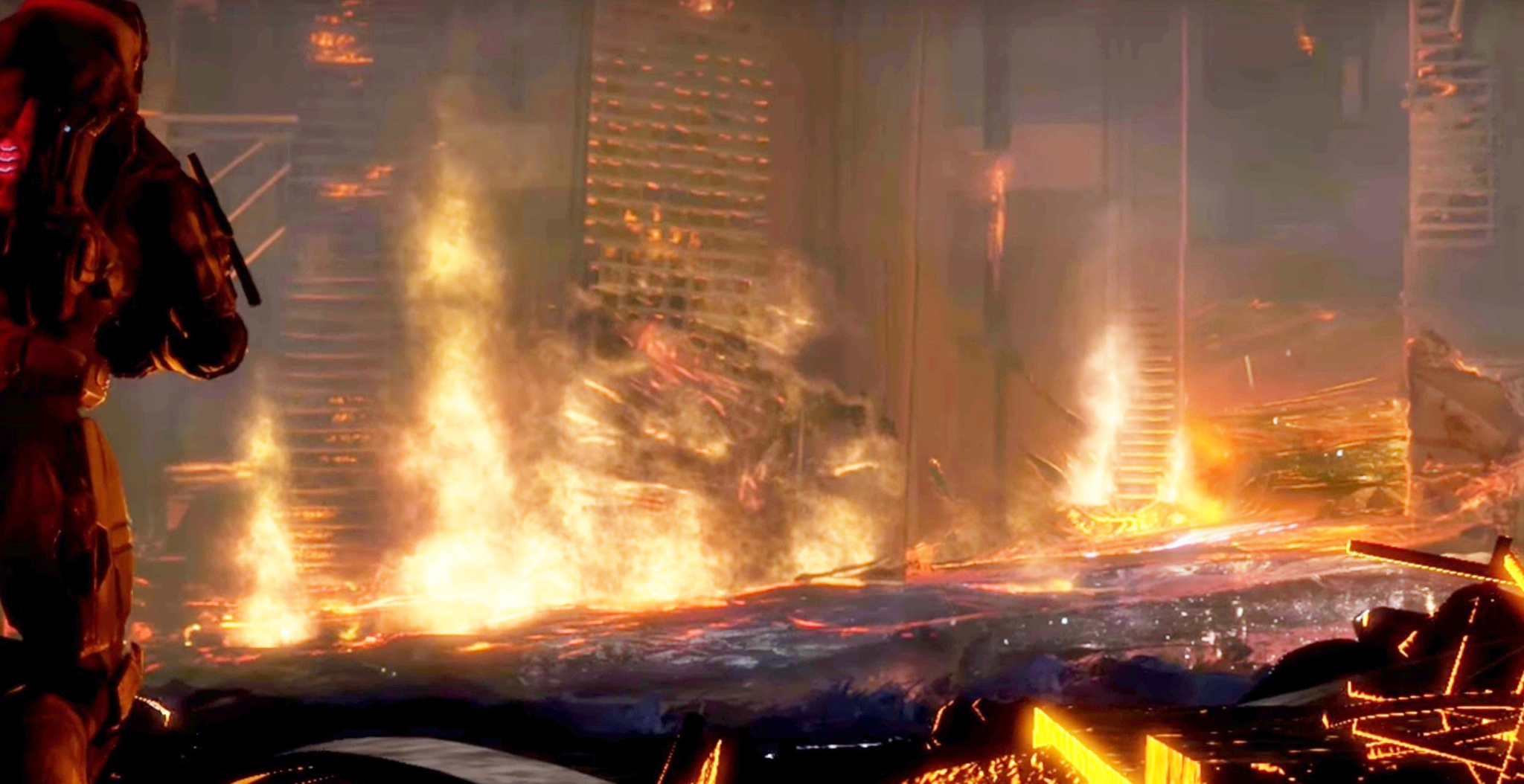
The impact of the plasma bolt is similar to that of a nuclear detonation on a much different scale. When the plasma bolt impacts the surface, the magnetic field sustaining and guiding the plasma collapses, and, depending on how powerful the release of energy is, the initial zone of impact is obliterated instantly. The areas outside of the initial impact zone are affected by the heat wave generated by the blast; depending on the range, those immediately outside the blast zone are usually killed instantly by the intense heat. As thermal expansion takes over, the resulting flames fan out and create a pyroclastic surge, which will continue to burn the areas it comes into contact with until it has cooled enough that it cannot harm the surface.
Subsequently, the atmosphere is saturated with soot and ash thrown up from the initial impact, subjecting the planet to a nuclear winter. As the initial impact area cools, the surface is covered by extensive areas of molten soil, and is comparable to active volcanic sites. The destructive process leaves the planet unable to recover to its former state. The atmospheres of most planets boil away from the process, though there are exceptions, the most notable being Reach.
Low range bombardment
The second method is used when a ship must effectively destroy a ground target from low range. This method involves focusing plasma though a magnetic envelope from the energy projector located on the underside of the ship, and then discharging the plasma as a narrow beam. This method of low-range glassing has only been witnessed a few times, most notably during the Harvest campaign, the Battle of Pegasi Delta, the Raid of New Alexandria during the Fall of Reach, and as the glassing of Voi during the Battle of Earth. This method of glassing can be used to excavate areas of interest for the Covenant, such as unearthing the portal to the Ark during the Battle of Earth.

Two types of low-range bombardment have been observed: a broader white/purple beam that is used for excavation, and a much more powerful blood-red beam intended for actual glassing. The difference may be a result of the intensity of the beam's energy.
Aftermath
Once a planet has been glassed, all life on the surface is melted or vaporised. Life cannot grow again without the use of re-terraforming. Once the surface has cooled down and hardened, the result is a glass like substance.
History
Since its formation in 852 B.C. the Covenant have used their ship-borne plasma weapons to threaten lesser species into a truce and their eventual induction into the Covenant. The Lekgolo were the first to be threatened with such destruction because of their transgressions against Forerunner technology before becoming the first outside species to join the Covenant in 784 B.C. The Unggoy almost faced orbital bombardment for their Rebellion in 2462 A.D, or the 39th Age of Conflict by Covenant records. Although the Kig-Yar were not threatened with orbital bombardment, they were quick to realize the Covenant had such a capacity to destroy them and thus chose to join the Covenant for the greater wealth the Covenant would provide.
Human-Covenant War
After the Prophets' declaration to wipe out humanity, the Covenant would put all of their destructive methods to use. Throughout the Human-Covenant War, the Covenant aggressors glassed a significant majority of the UEG's colony worlds from orbit. Although ground forces were often deployed first, as UNSC forces were routed in space, the bombardment would commence. The first planet to suffer this fate was Harvest, glassed from the Jiralhanae-operated cruiser Rapid Conversion.
The destruction of a human-controlled world depends on many different factors, from the world itself and its defenses, to the requirements of the Covenant fleet and its commander. Undeveloped human colonies such as atmospheric-contained habitats or stations are typically destroyed while the rest of the world is left unharmed. Well-developed planets that have been terraformed or inhabited are destroyed by many different methods.
It has been noted that areas of interest to the Covenant are left intact for reasons of study or retrieval; however, this is not common, as only three planets have been partially glassed, and only when a Forerunner Artifact was discovered. After the Covenant glasses a planet, a shard of glass is removed and placed in the Sanctum of the Hierarchs within High Charity.
The Battle of Earth culminated in the glassing of the city of Voi in Africa by Swords of Sanghelios, in an effort to contain a Flood infestation which had come to Earth only hours earlier. Lord Hood accused the Sangheili lead fleet of glassing half of the continent, but given his distaste for his former enemies, he might have exaggerated about the actual extent of the glassing.
Halo Wars
In Halo Wars, the Prophet of Regret's faction of the Covenant are able to use the Prophet to call down a Cleansing Beam from an orbiting Covenant ship. Rather than a leader power, this is treated as the unit's secondary ability, using the Y button to guide the beam at the cost of resources every second. It lacks the power of typical glassing maneuvers seen in past canon to balance gameplay, much like Captain Cutter's ability to fire a MAC blast at enemy targets.
Sources
Adapted from the original article, under CC BY-SA 3.0.