
Group
Jiralhanae
Most recent members of the Covenant
The Jiralhanae (Latin, Servus ferox, translated to "Wild Slave" ), known by humans as Brutes, are the most recent members of the Covenant. They are a large, bipedal, giant ape-like species from Doisac. The Jiralhanae have been part of the Covenant since before the destruction of the UNSC agricultural colony on Harvest, and were resented by the Sangheili for their monomaniacal behavior.
They are rated Native Tier 4/Adopted Tier 2 species by the Forerunner Technological Achievement Tier scale.
History
Despite their savagery and brutality, the Jiralhanae have proved intelligent enough to achieve spaceflight and space-faring status, though their warlike nature meant they quickly collapsed into civil war and afterward, fell back to their former pre-space status and learned nothing from the experience. The Jiralhanae had recently concluded a mechanized war of attrition in which the many Master Packs fought and pummeled each other back to a pre-industrial state when the Covenant discovered them in 2492. Having only just rediscovered radio and rocketry, the primitive Jiralhanae were quickly defeated and absorbed into the Covenant.

The Covenant
The Jiralhanae were the second Covenant species encountered by the humans following the Kig-Yar raid on the freighter This End Up. They were also the first Covenant species encountered by the Harvest Colonial Militia.
The Jiralhanae's plans to seize power over the Sangheili began with their alliance with the High Prophet of Truth during the Battle of Harvest and continued to gain headway until the eventual splitting of the Covenant. They eventually took the role of the Prophets' Honor Guards from the Sangheili after the Sangheili failed to prevent the assassination of the High Prophet of Regret by Spartan John-117. Regret's assassination culminated in the Jiralhanae replacing the Sangheili as the leaders of the Covenant military.
Post-Covenant
Though the Jiralhanae retained their pack and tribal culture, their constant internal feuds began to take a back seat as enmity with the Sangheili built up, caused by the similarity in roles between the two species. Though the Jiralhanae retained the majority of their pre-Covenant technology, they also began to incorporate aspects of Covenant technology into their own designs, such as mounting plasma cannons onto their Prowlers, vehicles with a strong Jiralhanae aesthetic but with some Covenant technology. The Jiralhanae have little need to learn the languages of other species, instead of relying on translation devices. Their exact fate, after the disastrous defeat at the Ark, is unknown, though it is extremely unlikely that they would surrender or retreat, or that the Sangheili would allow them to. A Sangheili Shipmaster visiting Kholo noted that at least some Jiralhanae factions had formed separate from the Covenant, waging an internecine war against each other and when the remaining San'Shyuum retreated into hiding, they returned to their primitive savage nature, allowing the Sangheili to gain the upper hand in battle. While the Sangheili may have held the upper hand they were also in conflict in their Civil War and other conflicts with Humanity. There were also small groups of Jiralhanae that were used as hired help on Sanghelios, however, it is likely that all of them were killed when they attempted to rebel against their Sangheili employers. At least a few Jiralhanae fought the UNSC during the Battle of Draetheus V, as part of Merg Vol's fleet. One Jiralhanae Chieftain, Lydus, helped the UNSC and Sangheili on the Arbiter's side break a peace agreement, and one of the few Jiralhanae that was actually willing to help their most hated rivals and the humans whom they had fought with for over 25 years.
Description
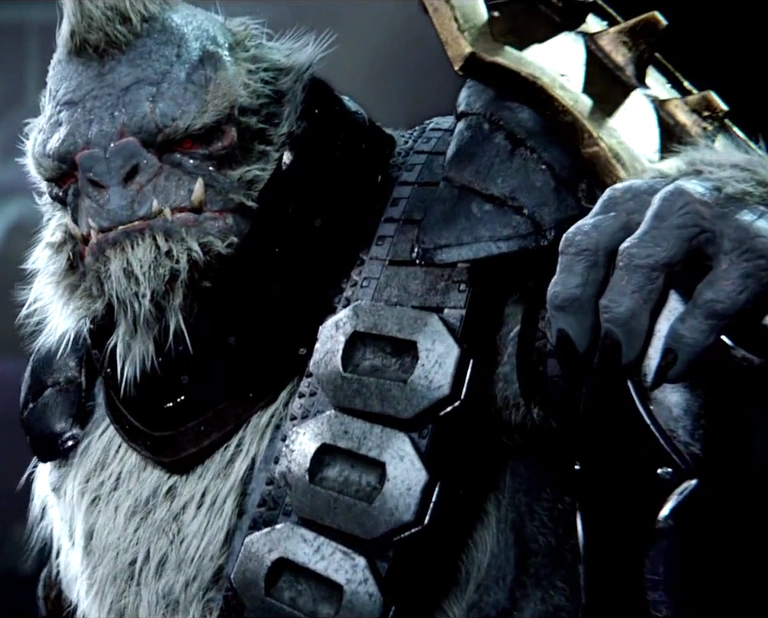
Jiralhanae are large, bipedal xeno-mammals of simian origin and have been said to resemble large gorillas, but, in some ways, they also resemble ursine, or rhinoceros as well. They have thick, gray skin, and are covered with matted, black, tan, or brown fur-like hair and some have short, black, or brown colored beards. Their large, stocky appearance is most likely due to the gravity on their planet, which is about twice the gravity of that on Earth. As they age, the hair will change to a grayish-silver color, which is a great sign of respect for all the Jiralhanae.

They have very sharp teeth and sometimes use them as a weapon. John-117 barely survived a hand-to-hand battle with one, proving how physically powerful they can be. However it should be noted that John-117 and the other Spartans were suffering from the non-stop combat they had endured since the battle of Reach, with John-117 sustaining, in Doctor Halsey's words, "Burns, brain damage, fractures, and internal bleeding." The other Spartans involved in the fight had sustained various injuries from falling over two kilometers at terminal velocity onto Reach's surface. It appears that their physical strength cannot be accurately quantified. However, in Halo: Ghosts of Onyx a Spartan emptied an entire magazine into a Jiralhanae and it was unfazed. Later another Jiralhanae managed to nearly knock a Spartan out and drain half of his shields, despite being shot in the face many times with a machine gun.
The Jiralhanae, with the exception of Tartarus, did not use energy shielding in Halo 2. In Halo 3, all of them are equipped with Power Armor that emphasizes their natural strength and power. Jiralhanae speak in deep, gravelly voices when speaking human languages and speak their native language as a series of grunts, hisses, roars and deep communal howls during ceremonies and for communication. Presumably because English is not their first language, they often speak without contractions, even during a fight.
In many military records, Jiralhanae are referred to as 'Bravo Kilos', since UNSC Marines have nicknamed Jiralhanae "Baby Kongs" or "Gorillas," a reference to King Kong.
Anatomy and Physiology
Jiralhanae are physically imposing enemies to face in combat. Standing at approximately 274 cm tall, they not only tower over their human opponents, but the majority of their Covenant allies, with only Mgalekgolo standing taller than themselves. They have thick, gray skin that is extremely resilient to battle damage.

In their first appearance, they are covered in thick, shaggy fur that offers further protection. It covers most of the body except for the head and the shoulder blades. However, the Jiralhanae in Halo 2 are shaggier than those of Halo 3. In Halo 3, the Jiralhanae have what looks like scales on their arms, but it may have been extensions to their armor, or simply their thick skin, as seen from McFarlane action figures. Jiralhanae exhibit two colorations: brown and gray. This is perhaps an indication of age, since lower ranking Jiralhanae are brown and most Honor Guards, and Tartarus himself, are grey. In Halo 3, they are seen with shaven faces, which increase the fearful effect they have on opponents.

In Halo 3 Jiralhanae have mixed red-and-blue blood (on first glance they look completely red, but on closer inspection one would see blue spots in pools of Jiralhanae blood). At a casual glance, it appears purple. In Halo 2, however, it appeared black.
Jiralhanae resemble a cross between an ape and a rhinoceros, being taller and more muscular in the torso and limbs than a human, and having the same weight and height as an average male polar bear.
Heavily muscled and possessing animalistic brutality and strength, Jiralhanae can rely on close combat to defeat their enemies, even more so than their Sangheili counterparts. However, their great strength may in fact be simply relative, due to the species' evolution on a world with twice the gravity of Delta Halo, Earth, and other planets and structures with one 'g'. Featuring characteristics simian, ursine, and alien, their appearance fits their human given name.
Jiralhanae are obviously carnivores, given their fearsome fanged jaws and propensity for violence. It has been stated that they feed on the flesh of their enemies, such as the Humans they face in battle, and have been seen eating the meat of a Thorn Beast, apparently considered a delicacy among Jiralhanae. A Jiralhanae once stated he would have gladly devoured the future Arbiter, had he been allowed.
Jiralhanae have digits on each hand including opposable thumbs. As such, they can make use of a variety of weapons both of Covenant and human design. Their feet have only two digits. The Halo 3 Tartarus figure has a red tongue but if this is canon is unknown. When it comes to ranged conflict Jiralhanae show a tendency to use large, rapid firing, often powerful weapons. This may be indicative of their mentality and an extension of their brutal nature. The many spikes and serrated edges that adorn their race's weapons, vehicles and armor further exhibit this. It is interesting to note that in Halo 2 Jiralhanae can be seen using human shotguns. Jiralhanae sometimes wield their own shotgun-style handguns, the Maulers, in Halo 3.
Jiralhanae are not as mentally slow as they may appear, and are often fairly cunning tacticians. As such, they can pilot vehicles & ships and command both land-based & fleet encounters with strategic competence, albeit lacking in artistic flair. They also have a higher vocabulary than other members of the Covenant apart from Sangheili and Prophets.
Jiralhanae are known to descend into a highly aggressive berserk killing-rage when all their pack mates have been killed. Their incredible physical strength coupled with a dogged self-determination to kill their target makes a berserk Jiralhanae a force to be reckoned with, powerful enough even to kill Mgalekgolo (if they slam into the Hunter enough). Also, when berserking, they will not hesitate to attack an enemy, even if the target is in a vehicle, such as a Ghost. If the target is in a Spectre or Wraith, they will board it and attempt to kill (in a Wraith) or force the enemy out (such as in a Warthog or Spectre). Interestingly, they will neither attack nor hijack a low flying vehicle (such as a Banshee).
There is a substantial difference between the Jiralhanae of Halo 2 and Halo 3. The Jiralhanae of Halo 2 had very little armor, were unclothed and unshaven. The Jiralhanae of Halo 3 were largely shaven, clothed in tight-fitting garments that reflected their rank and were adorned with Power Armor. This probably had something to do with the Jiralhanae' new-found rank after the Sangheili' split from the Covenant.
The aesthetic and graphic differences between the two games also had a strong dichotomy between them, for the Jiralhanae in Halo 2 were less detailed and less anthropoid than they were in Halo 3. This is a result of the technology available at the time the two games were made.
In Halo: Contact Harvest, it is stated that before Jiralhanae reach full maturity, they naturally release pheromones. Other Jiralhanae can smell these pheromones and tell how others are feeling by the scent. When they do reach maturity, they learn to control the releases of their pheromones and most likely stop them all together.
Culture
Their home world is war-torn, and Jiralhanae are known for their particular joy in vicious activity, complimented by regimented discipline.
Role within the Covenant
Their warlike culture makes them highly formidable opponents, even for Spartans, and they were incorporated into the Covenant to serve as temple guards and as heavy shock troopers. In combat, Jiralhanae are used as a form of secret service or secret police, acting on behalf of the Prophets, doing much work behind the scenes. Examples of Jiralhanae roles are the patrols that went ahead of the Arbiter during the Battle of Installation 05 to try to lower the Sentinel Wall's shield, policing of the Covenant occupied New Alexandria, and assaulting the underground Forerunner artifact on Reach. It is also important to note that the Covenant fleets are mostly segregated, with Sangheili fleets and Jiralhanae fleets not intermixing. This is probably done to prevent authority issues within the ranks. This may explain why there were no Jiralhanae in Halo: Combat Evolved, as the soon to be Arbiter would not have had Jiralhanae in his fleet. These fleets did battle during the Great Schism, around the infested High Charity and Delta Halo. By the time of the events of Halo 3, the Jiralhanae had completely replaced the Sangheili, who had left the Covenant and formed the Covenant Separatists.

Government and Social Structure
Jiralhanae have a fierce pack culture and lineage, a close knit affair that ties each member to another, and forces them into varying states of rage known as "berserking," and desperate mourning for their fallen pack mates should one die in the midst of battle. What a pack member kills may be the food of the pack. Each pack is led by a prominent Jiralhanae Chieftain that wields a ceremonial Gravity Hammer, passed from one leader to another upon his death, to denote his status. A Jiralhanae becomes a pack Chieftain of the Jiralhanae by challenging the current Chieftain to a Mortal duel; the victor claims the title after executing the other. the chieftain rules his pack like his own little empire. Their warrior culture is extremely patriarchal, with rank measured by success on and off the battlefield, unlike the Sangheili.

It is unlikely, given their combative and aggressive nature, that the Jiralhanae have a single cohesive government. Instead, Jiralhanae society can be viewed as an extension to the simply pack structure, but with a number of different levels:
Alpha Tribes - seem to be the political body of the Jiralhanae, and are comprised of smaller Master Packs. Lead by Alpha Jiralhanae.
Master Packs - more military oriented groups, Master-Packs are comprised of many smaller packs. Prior to contact with the Covenant, rival Master Packs reduced Jiralhanae society to a preindustrial level through warfare.
Packs - range in size and importance, with less important packs made up largely of Unggoy or Kig-Yar forces and led by a low-ranked Jiralhanae, and more important packs led by War Chieftains and comprised of more experienced veteran Jiralhanae bodyguards.
Relations with other Species
Sangheili
The Jiralhanae have an extreme hatred of the Sangheili, unmatched by any other feud within the Covenant, fueled by the Jiralhanae's natural aggressive nature and the Sangheili's attitudes of superiority.
In general, Jiralhanae have a pronounced dislike of the Sangheili, due to the fact that they believe that they are better protectors of the Prophets than the Sangheili. The Prophet of Truth took advantage of this to ignite the Great Schism.
Despite having been absorbed into the Covenant in 2494, Ghosts of Onyx describes the feud between the Jiralhanae and the Sangheili as "ancient," giving us a (possibly) false hint about the two races have been fighting before.
Technology
Even at a glance, the Jiralhanae are one of the most primitive members of the Covenant, at least technologically. Even though they employ Power Armor, and use a selection of the Covenant's weapons such as the plasma rifle, their native technology is crude; they often use weapons propelling spike-like or explosive projectiles. These weapons are often fitted with effective metal blades for melee combat.
They prefer using weapons from their homeworld Doisac, rather than the Covenant standard-issue plasma-based firearms. Jiralhanae weapons are notable for being extremely dangerous, somewhat primitive and brutal, and always featuring a blade attachment such as the Spiker, Mauler, Brute Shot, and the Gravity Hammer. These weapons show their barbaric nature, for example, the fact that all of the weapons are named after ways of injury or causing bodily harm to another being. Although they do have their own type of Plasma Rifle, it is only found in Halo 2 and Halo 3: ODST (the rifle is red, but fires twice as fast compared to its blue counterpart, also causing it to overheat twice as fast). This type of Plasma Rifle was removed in Halo 3, being replaced by the Spiker.
Given the absence of power armor at the time of Halo 2, it is possible that the Jiralhanae that were seen were members of Tartarus' pack and/or a subset of the Jiralhanae that shunned the use of extensive protection and emphasized relying on their own strength, skill, courage, and ferocity to protect them, or that all the Jiralhanae you encountered in Halo 2 are from Maccabeus/Tartarus' clan and were banned from wearing armor due to their failure at Harvest. It is also possible that the Jiralhanae of Halo 2 were second in rank to the Sangheili and the Prophets. Following The Great Schism, the Jiralhanae became the Prophets' main protection, and it became a necessity to outfit them with more advanced equipment.
Religion
As part of the Covenant, Jiralhanae were required as a prerequisite to convert to the Prophets' religion of worshipping the Forerunners. Previously, their culture revolved around the worship of totems and idols, but they made swift converts. The Jiralhanae are now the most fanatical adherents to the Prophet's faith, although they seem to hold little to no concept of sanctity, evidenced by Tartarus' handling of the "Oracle".
Jiralhanae are extremely zealous creatures, known for their willingness to cling to ancient, bloody traditions and are deep believers in the promise of the Great Journey and in the Forerunners, but despite this devotion, the Jiralhanae are quite intelligent, even though they don't appear so.
Naming
Most known Jiralhanae have Latin-sounding names, such as Tartarus and Bracktanus. In Contact Harvest, it is revealed that the "-us" at the end of their name is an honor denoting maturity or experience in battle (similar to the "-ee" suffix on Sangheili's names.) However, it is possible that different naming conventions are used among different tribes, as evidenced by the names of Gargantum and Parabum.
Homeworld
Doisac is the name of the Jiralhanae home world. It possesses three satellites: Warial, Solrapt, and Teash, and is the fourth planet of the Oth Sonin system. The gravity on the planet is approximately 2.1G while the atmosphere is 1.3 ATM. Surface temperature is between -15'C to 52'C. The estimated population of the planet is approximately 12.5 billion. Its habitat is described as being dominated by magma and magnetism.
Rank Structure
The Jiralhanae species is arranged in a pack society, based on a hierarchy determined by viciousness and number of war kills. A “Pack Master” leads Jiralhanae packs. A Chieftain will frequently be addressed as such while issuing orders during combat. In Halo 2, the ranks were mostly determined by red flags on their backs, the amount of armor they wore and the color of their fur (sometimes even their weapons). Like the Sangheili, ranks in Halo 3 are differentiated by armor color. Furthermore, the higher the rank, the more advanced and resilient the armor becomes.
- Rank Image Description - Jiralhanae Chieftains - War Chieftain Incendiary grenades or their weapon can by any sticking grenade for an immediate kill. Identification: Dark Golden Armor. - Chieftain Incendiary grenades. Also, their weapon can be stuck by any sticking grenade. Identification: Black and Red Armor. - Jiralhanae Captains - Jiralhanae Captain Ultra Brute Shots and Fuel Rod Guns. Identification: Cyan/Cobalt Armor. - Jiralhanae Captain Major The Jiralhanae Captain Majors are even more experienced than their younger comrades and lead larger packs into battle. Also usually wield Brute Shots and Fuel Rod Guns. Identification: Golden Armor. - Jiralhanae Captain The Jiralhanae Captains are experienced Jiralhanae who now lead their comrades and the lesser races into battle. Identification: Purple-Red Armor. - Jiralhanae Specialists - Jiralhanae Honor Guardsman High Prophet of Regret. They are exclusive to Halo 2 and are some of the best warriors the Jiralhanae have. Identification: Orange, Yellow and Red Ceremonial Armor; Red Flag. - Jiralhanae Bodyguard Jiralhanae Bodyguards are some of the chieftain's most reliable warriors and not only protect their Chieftain, but enforce his tribal law. They seem to be the Halo 3 Jiralhanae counterparts of the Sangheili Honor Guardsman and Honor Guard Ultra Units. Identification: Grayish-Blue/Steel Blue armor. - Jump Pack Jiralhanae These veteran Jiralhanae utilize jump packs to launch aerial attacks from afar, and use their enhanced mobility for guerrilla battle tactics. They seem to be the Jiralhanae counterparts of the Sangheili Ranger Units. Identification: Jump pack, Gold armor. - Jump Pack Jiralhanae Major Ranger Sangheili Units. Identification: Jump pack, Orange armor. - Jump Pack Jiralhanae Minor Ranger Sangheili Units. Identification: Jump pack, Blue armor. - Jiralhanae Stalker Maulers. - Jiralhanae Infantry - Jiralhanae Ultra Jiralhanae Ultras are now armed with violet Armor, they are comprised of the best of the regular infantrymen, showing tact, cunning skill and strength. Identification: Indigo armor. - Jiralhanae Major Jiralhanae Majors are clad in dark blue Armor and are promoted in a similar fashion to the Sangheili. They are promoted on the casualties they inflict. Identification: Blue armor. - Jiralhanae Minor Jiralhanae Minors are the lowest rank of the Jiralhanae race, clad in turquoise Armor and typically armed with the Type-25 Carbine. Not only do they compete for their posting but also for their equipment. Identification: Teal-Green armor, unarmored in Halo 2.
Also in Halo 2, Jiralhanae Minors are seen with little to no armor, the only armor being a helmet-like head plate which, ironically, gives no protection from headshots from even the weaker weapons such as the Plasma Pistol and Magnum. It is known they do not switch weapons at any time.
Other Ranks
Chieftain of the Jiralhanae - The Leader of the entire Jiralhanae race. Both Maccabeus and Tartarus were of this rank. Since Tartarus was killed in the Battle of Installation 05, the current Chieftain is unknown, if there is one at all.
Jiralhanae Shipmaster/Alpha Jiralhanae - Commanders of ships. They may be equivalent to Naval Captains.
Jiralhanae Army Commander - Only ever witnessed in Halo Wars, they are probably similar in authority and purpose to a Field Master. May be a specific rank created for war and conflict, such as the Human-Covenant war.
Gameplay
Unlike the Sangheili, who are masterfully skilled tacticians, the Jiralhanae combat mentality relies on overwhelming force, sheer strength, and incredibly strong firepower, hence the name "Brutes." They are easily enraged, and when provoked, will drop their weapon and charge their opponent recklessly.
Halo-fans have often argued about Sangheili and Jiralhanae and their combat-ability. It depends on the situation. Sangheili rely on intense tactical strategies, superior technology and agility. Jiralhanae, on the other hand, rely on their gigantic figures, physical endurance, and strength in numbers.
In Halo 2, a berserking Jiralhanae can sometimes kill several shielded Sangheili Honor Guards if they aren't equipped with Energy Swords, however this is mostly due to the fact that Jiralhanae in Halo 2 were added in at a late stage of production, and, due to time restraints, were left without much testing, making them rather overpowered foes.
In Halo 3, Jiralhanae are properly balanced out, and on the level The Covenant, the 5 Sangheili assisting you can generally equal 7-9 Jiralhanae with no assistance. Sangheili and Jiralhanae, in the story The Return in Halo: Evolutions - Essential Tales of the Halo Universe, were told to be somewhat equally matched in ground battles, with casualties on both sides, when there was no technological disparity between the two. In space, however, the Sangheili were superior, evidenced by the Battle of Installation 00, when the Sangheili, while outnumbered, were able to destroy most of the Jiralhanae Fleet. Eventually, due to the Jiralhanae' inability to maintain cohesion in the ranks, were made easier prey for the Sangheili. The Sangheili are certainly more well-trained than the Jiralhanae. On the other hand, the Sangheili rigid adherence to their code of honour holds them back from being the best tacticians they could be and the Jiralhanae's lack of code of honour is a crucial advantage to them in combat.
In Halo: Reach, the inclusion of the Needle Rifle vastly reduces any danger posed by groups of Jiralhanae, as 3 hits from the rifle will result in a fatal supercombine explosion, allowing the player to defeat up to 7 of them without having to reload the weapon.
Sources
Adapted from the original article, under CC BY-SA 3.0.