
Lore
Forge World
Multiplayer map in Halo: Reach intended for use as a "blank canvas" for Forge
Forge World is a multiplayer map in Halo: Reach intended for use as a "blank canvas" for Forge. The map encompasses several different regions and environments which allows users to create entirely new maps of varying sizes, similar to the three distinct areas in Sandbox from Halo 3.
History
Forge World began development as five separate maps designed for use in Forge. To cut development time, it was decided that each map would take place inside the same skybox, allowing fans to see hints of the other maps in the distance but preventing players from leaving the map. To make artistic development easier, a version of the map existed which allowed movement between and throughout the five areas. Because of a new system in Halo: Reach's game engine called "Impostering," which allows distant objects to be drawn cheaply, it was decided that it was feasible to actually allow players to play across the entire expanse of the development map. At this point, the five maps were combined into a single map later dubbed "Forge World."
After the five original maps were combined to create Forge World, four new areas were added to the map between them, giving Forge World a total of nine regions and making it the largest multiplayer map in the series.
Locations
The following are locations around Forge World as seen in players H.U.D. MTNI (Motion Tracker Navigational Identifier).

The Canyon
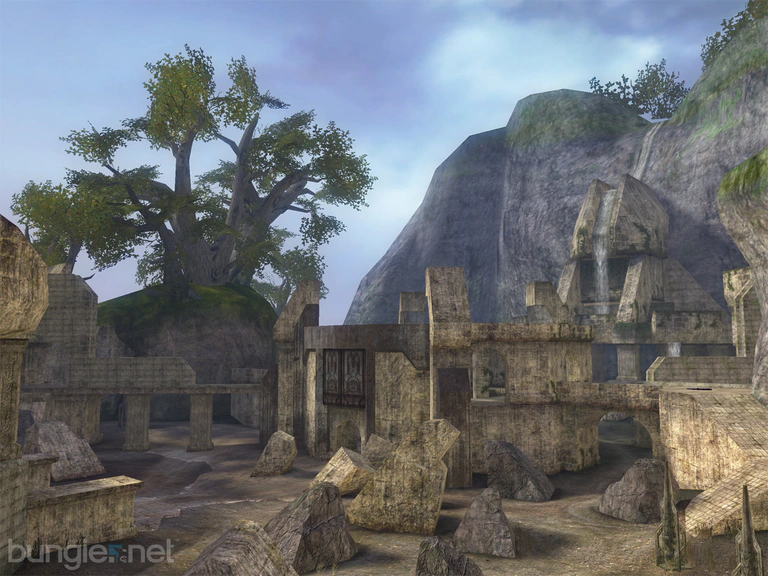
The "Canyon" is a semi-enclosed, symmetrical canyon in the south of the map, with a large open field and a drying river in its center. Along the edges of the canyon are several walkways and caves. One end of the canyon opens up onto the lake while the other can be ascended into Alaska. The Canyon is designed for easy traversal in ground vehicles and is recommended for larger, team-based games. Other than an increase in size and some environmental changes, this area of the map is a faithful and accurate remake of the Blood Gulch canyon, which plays host to Hemorrhage, a remake of Blood Gulch and Coagulation.
The Island
The "Island" is a large area in the center of the map. The Island is roughly symmetrical, with a large rock formation at the center and a small bay on one side that molds this area into a horse-shoe shape. There is a small tunnel that cuts through the center rock. The Island is designed for vehicular combat and is recommended for larger, team-based games. The Island was designed to be vaguely reminiscent of Sidewinder, thus the horse-shoe shape of the map.
The Quarry
The "Quarry" pocket is a small roughly rectangular grassy patch enclosed on three sides by rock cliffs with a view overlooking the entirety of the map on the fourth side. The Quarry is positioned directly above the Coliseum section of the map. The Quarry is described as about the same size as Sanctuary, with Asylum, a remake of Sanctuary, appearing in the Forge World ViDoc.
The Coliseum
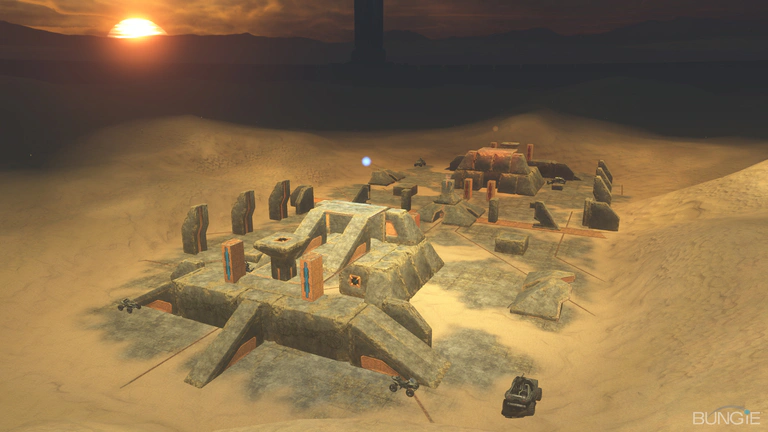
The "Coliseum" is an enclosed area reminiscent of the Crypt from Sandbox and appears to be made of Forerunner alloys. The entrance to this area is located directly under the Quarry on the side of the cliff in the far north corner of the map. This area of the map was designed to give forgers a traditional area to forge. The entrance side of the Coliseum can be blocked off with a Forge piece (Window, Coliseum) designed specifically with this in mind, or left open to give players a view of the lake. This is where the Grifball court is occasionally located in Matchmaking.
The Pillar
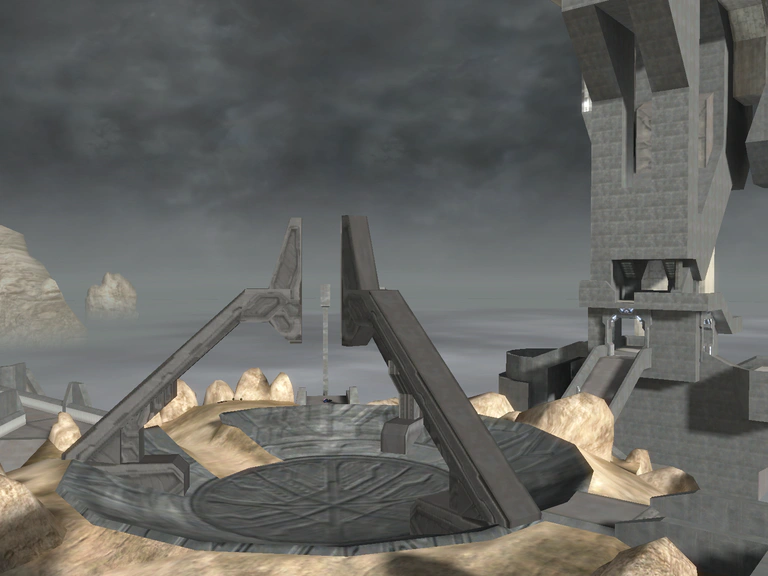
The "Pillar" is a tall spiraling column of rock stretching out of the lake in the same general vicinity of the map as the Quarry and the Coliseum. The Pillar has been referred to by Bungie as "The Rock," despite the fact that this location is named "Pillar" in players' HUDs. It was modeled after Ascension from Halo 2, and is the site of Pinnacle, a remake of Ascension.
The Coastline
The "Coastline" area applies to all locations along the coast where another area does not intersect with itself; because of this the majority of the Coastline area is on top of water from the lake. The majority of playable space (actual land) in the Coastline area is a stretch of beach positioned in between Alaska and the Island; this area of the Coastline features a large cave at one end and multiple spots to forge across a small inlet to reach the island.
The Lagoon
The "Lagoon" is a large sea cave positioned along from the end of the Coastline area of the map, and is located below and to one side of the Coliseum's cliff entrance. The Lagoon features three cascading waterfalls, and a large cliff face with a half-dome hollow cave reaching in. It is also adjacent to the Island, which can be seen clearly from the area. The Lagoon is also the site of Bungie Representative Urk's first Forging attempt, first entitled Jurkout, then Riptide, featuring several platforms just below the surface of the water. The Lagoon is the only area of Forge World with no solid land (aside from the top of the cliff).
Alaska
"Alaska" is a grassy area surrounded by cliff faces on all sides. It is positioned in between the Coastline and the Canyon. A small gully leads down into the Canyon from one side of the map. Alaska and Montana are similar in their classic Halo terrain appearance. Notable differences, however, are Alaska's lack of visible terrain cliffs or edges, instead having only rolling hills. It also features scattered trees, which are part of the map geometry and hence cannot be altered. Alaska is also one of the areas of Forge World located on the edge of the immovable map boundary, which prevents any players from truly 'leaving' the level.
Montana
"Montana" is a rocky, mountainous area of the map taking place on top of a plateau. Montana is positioned in between the lake and the Canyon, forming one of the Canyons walls. While sharing a classic Halo terrain appearance, Montana differs from Alaska in appearance in that its terrain is generally more rough, rugged, and varied with fewer flat sections. The terrain is heavily populated by rocks and similar environmental pieces, which cannot be moved or deleted.
The Plains
"The Plains" is the nickname given to the huge expanse outside the actual map itself. Virtually every part of the Plains is covered by a hard-coded soft kill area. When looked at in Theater, it takes about two hours (assuming unchanged camera settings and the use of LT to boost) to reach the invisible wall at the end of the map, and about 20 minutes to reach the invisible ceiling at the top. As such, The Plains are estimated to be around 100 times the size of playable Forge World, although objects cannot be placed on it as it is only accessible through using glitches.
Map variants
The following map variants are included with Halo: Reach. These map variants were developed by Bungie using the Forge 2.0 tool set in order to demonstrate Forge 2.0's increased user-friendly capabilities.
Three new maps were also released on October 15, 2010 with the Bungie Weekly Update.
/Asylum/ (Sanctuary remake)
/Hemorrhage/ (Blood Gulch remake)
/Paradiso/
/Pinnacle/ (Ascension remake)
/The Cage/
Atom
Cliffhanger
/Uncaged/
Sources
Adapted from the original article, under CC BY-SA 3.0.