
Thing
D77-TC Pelican
Extremely versatile aircraft used by the UNSC
Class History
Sometime before 2501, the D77 was commissioned.
Human-Covenant war
The D77's usage during the Human-Covenant war was as early as the Harvest Campaign. More would appear during the Battle of Arcadia, and the Battle of Shield 0459.
Design
The D77-TC Pelican is mainly used for the rapid insertion and extraction of ground troops. They may deliver vehicles and vital equipment to the battlefield when required. The D77-TC has been in service for over fifty years, and is the primary tactical support aircraft of the UNSC. The Pelican is a multi-role aircraft; it is fully capable of atmospheric flight and can land almost anywhere without difficulty.

The Pelican is also capable of limited spaceflight, which the UNSC uses as a primary method of delivering troops to the surface from orbit. Standard armament consists of one Class III externally powered projectile weapon at the bow of the craft, and one Class I gas-operated projectile weapon mounted at the rear, in the extended crew area. More heavily armed variants do exist, with multiple and more powerful weapons.
The D77-TC also features motion trackers
Armament
Standard armament consists of a chin-mounted 40mm rotary cannon which was common prior to 2525, but was later superseded by a 70mm chaingun. These weapons are usually controlled by the pilot's helmet so that it would aim in the direction of the pilot's view, similar to the 21st-century TADS/PNVS found on Apache gunships or the HUD system in a SPARTAN's armor. Some dropships boasted twin chainguns firing depleted uranium rounds.
Missile pods, each holding eight ANVIL-II ASMs, can be mounted under each wing to engage more maneuverable or better protected targets. Fire control is typically delegated to the copilot, who is assisted by a helmet-mounted display. An M247 GPMG or a 25mm grenade launcher can be mounted facing out of the rear cargo hatch; the weapons can be folded flat against the roof of the internal bay when not in use by the crew chief or a passenger.
Propulsion
The main engines are mounted in pairs in four nacelles, one on each wing and two at the rear. The nacelles can articulate independently, thus altering (i.e. vectoring) the direction of thrust and improving the dropship's low altitude maneuverability. Six ventral thrusters, two on each wing nacelle and one on each aft nacelle, allow the Pelican to land and take off vertically. These engines are capable of both space and atmospheric operation. The D77, although fully capable of orbital insertion, is too small to be equipped with a Shaw-Fujikawa Translight Engine, and thus is incapable of slipspace travel.
The wings mounted on a Pelican seem extremely small, too small to support the weight of dropship and payload alone. It is speculated that it incorporates at least some lifting body principles, its own hull providing most of the lift necessary.
Payloads
The Pelican is capable of carrying passengers and cargo using a combination of internal and external methods.

The large aft overhang gives an attachment point for additional cargo and ordnance. Possible payloads include a Troop Deployment Pod, a Scorpion Tank, a Warthog, eight Resupply Canister Type-B Capsules, or a Portable bridge.
D77s are not rated to carry combat vehicles in whole from space to the surface of planets. Instead, if they are needed to make such deliveries, they must carry down crated portions of the vehicles and reassembled near the operational area.
Capacity
The main compartment of the Pelican (sometimes called the "Blood Tray") has capacity for 15 people (10 sitting, 5 standing). Other variants have displayed the ability to hold considerably more as demonstrated. For example, the SPARTAN-II's were assigned a specialized Pelican, which was able to hold an entire team of twenty five, as well as fitting cutting gear to board a Covenant warship. Three Pelicans used for the SPARTAN-III Program carried 300 children, though this may have been because of numerous trips back and forth from the surface.
The maximum payload of a Pelican is seventy tons.
Variants
- Picture Variant Description - D77H-TCI Pelican Dropship In many ways the D77H-TCI is similar in appearance to the plain D77, except for being more angular. Internally, though, the craft has been renovated and it can store equipment in overhead netting. The cockpit has been altered, and instead of the side-by-side positioning of the pilot and copilot, the pilot now sits at the fore of the dropship, with the co-pilot behind him/her, and at a higher position, in tandem. - D77C Dropship PageName=Universe - Pelican - D77C-NMPD Pelican Dropship A variant of the D77C, operated by the New Mombasa Police Department, it is differentiated from its military counterpart by a black and white colour scheme, "POLICE" replacing the traditional "MARINES" on the external hull, and a noted lack of armament. Under the craft's chin, where a machine gun turret or autocannon would normally be installed, are various interchangeable sensors used by the police for aerial surveillance and crowd control. - G77S Gunship UNSC Spirit of Fire in 2559.
Naming
Pelicans receive serial numbers to be identified by during radio transmissions, particularly in combat situations. Each serial number consists of a letter from the Phonetic Alphabet followed by a number. Though a few Pelicans have this number inscribed on their cargo bays, most have no distinguishing mark on their exteriors. It is unclear how the numbers are chosen, but with their spread across the alphabet and numerals, it can be inferred that a very large number of Pelicans are in service, perhaps as many as 26,000.
Gameplay
Generally the D77 can not be piloted or operated by the player, but often delivers ordnance during battle or is the starting point for the mission. However, it is possible through Glitches or Easter Eggs.
Halo 2
There is a glitch in the Halo 2 level Metropolis where the player can ride the Pelican. It will take the player out of the map, flip, and eject the player. If the player attempts to right the flipped Pelican, the script will read "Hold X to flip Banshee," because Bungie never intended for the Pelican to be operable by the player, and therefore did not make a unique message. The Pelican's in-game physics will make it impossible to correctly and permanently flip the Pelican, as it will always reposition itself in an upside-down position.
Halo Wars
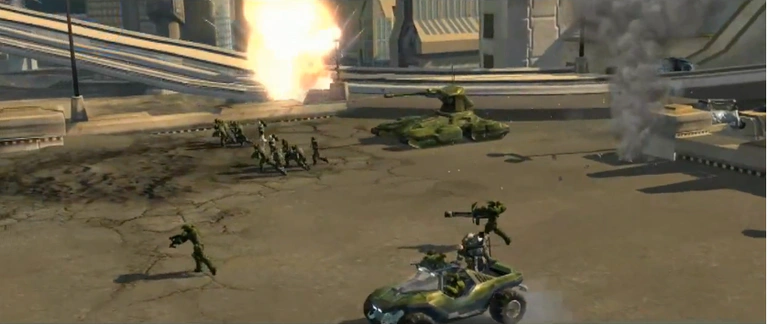
In Halo Wars it is possible to summon a Pelican to transport cargo in order to avoid units that take too much time to get to your destination if they travel on foot. Select the 'Spirit of Fire' menu, then use the left analog stick to choose the 'Pelican' and get the forces you want transported into the cargo ship. However, the Pelican can sometimes be destroyed if its HP is too low, so you might need to quickly unload the cargo before it goes down. All your units onboard will be lost if the cargo transport is shot down.
Halo: Reach
In Halo: Reach you are able to pilot the Pelican on the campaign mission New Alexandria through an easter egg. To do this, you must go to the level New Alexandria and deactivate all the jammers, then go to the building on the right side of Club Errera and press a switch located on the bottom of the building's overhang. Then take your Falcon through a building with a large circular hole in it nearby and your Falcon will be replaced with a Pelican. Doing the same with a Banshee will give you a Phantom.

The above information combined with the fact that one can enter the turret of the Pelican on the level Long Night of Solace seems to indicate that Bungie intended for Pelicans to be flown in game, during Halo: Reach but decided against it later on, or were experimenting with including it in a future release. Certain in-game models of the Pelican (there are many) are near completion, only missing entry prompts, having the Pilot position "locked," the bugs with the turret that prevent one from seeing out of it and it continuing to fire after destroyed, and also not being destructible. The Pelican in Long Night of Solace actually has a landing and take off animation if you hack yourself into its cockpit, where the ramp and gear are retracted upon entry and extended after one gets back out. No model of the Phantom has a similar animation.
Sources
Adapted from the original article, under CC BY-SA 3.0.