
Thing
Pulse beam
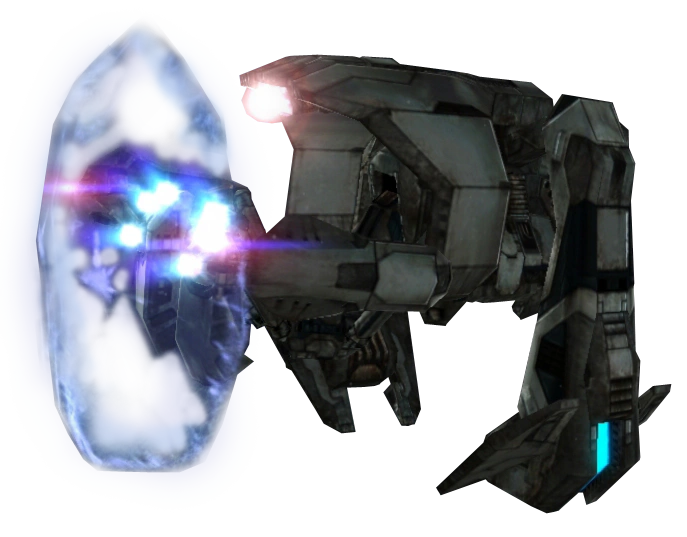
Pulse Beams are a form of weaponry used by Forerunner Enforcers, large machines…
Pulse Beams are a form of weaponry used by Forerunner Enforcers, large machines used for combating the Flood and other sentient beings.
The pulse beam's original purpose was to combat the Flood by vaporizing the host bodies and Flood forms to prevent reanimation. Due to the sheer amount of projectiles fired at once, and due to the sharpness of the projectiles, the projectiles easily penetrate flesh and most armor, making it an effective weapon. This would have been an important part of the design for the Forerunner, as controlling the outbreak of flood was critical.
Since the projectiles have high energy power, they are also useful for combating other sentient beings, such as Spartans and Elites. However, like other attached weapons, they can be blown off to render the Enforcer harmless. The pulse beam is only one weapon used by the Enforcers, and is generally intended for use against infantry. The weapon is mostly ineffective against vehicles, so a more suitable weapon is used in its place.
Projectiles
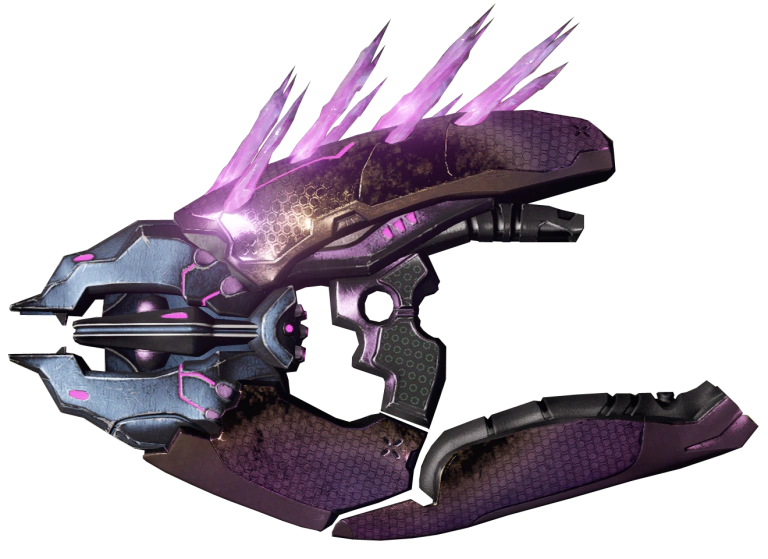
The projectiles fired from the weapon are red, rapidly-firing projectiles, similar in appearance to that of the Needler, except with subtle differences, and do not have the homing or explosive abilities that the Needler has. Once the projectiles have made contact with an enemy, they "shatter" within a few seconds, just like Needler rounds. However, pulse beams do not create the same explosion as Needler rounds do when stuck with 7 or more projectiles. The projectiles travel at roughly the same speed Needler rounds do, though lack the homing capabilities, so avoiding them is generally easier. They also travel a considerable range, giving Enforcers a decent advantage over the Flood as they can fire from long ranges and heights.
It can be assumed that the pulse beam is a heated weapon, as with all other Forerunner weaponry. This is because heated weapons are the most effective against Flood forms, as they burn any usable body or Flood form so that the parasite cannot use it.
Also, as seen in Halo 3, in the end cutscene of Floodgate, 343 Guilty Spark's weapon is shown as being heated, too. This suggests that most, if not all Forerunner weaponry is heated, so it is acceptable to assume pulse beams are too, though this is merely an assumption.
Halo 2: The Official Strategy Guide
On page 119of the Halo 2 Strategy Guide, the following description of the Enforcer weaponry can be found:
Note: The guide has a typing error. "Sentinel Major" should have been "Sentinel Enforcer." It was incorrectly typed in the Strategy Guide.
As the description suggests, whilst the weapon can be deadly, it is generally weak if appropriately avoided. Individual projectiles are of little consequence, but the player should avoid being hit by multiple projectiles, as they easily bring down shields.
Gameplay
Enforcers generally fire pulse beams at infantry units only, saving the mortar weaponry for vehicle based units. When fired, waves of red projectiles are fired towards the Enforcer's enemies. These are difficult to dodge head-on, but can be easily avoided if there is suitable cover, or if the player keeps up a constant pace to the side. The weapon is used only against infantry, as it would be generally ineffective against most, if not all vehicles, as the driver or pilot is generally well defended or hidden from direct view. Therefore, the Enforcer uses it's mortar-like weapon to combat vehicles.
The weapon can easily defeat weak, unshielded units, such as Grunts, and even Jackals can have trouble using their shield to effectively block the projectiles. When used consistently, the weapon can keep an unshielded or wounded enemy pinned down for a considerable amount of time, and can be very distracting and frustrating when trying to defeat the Enforcer. Therefore, it is usually a preferable tactic to disable the Enforcer's weapons first.

Levels Encountered
Note: Enforcers were only featured in Halo 2.
Related Pages
Sources
Adapted from the original article, under CC BY-SA 3.0.