
Lore
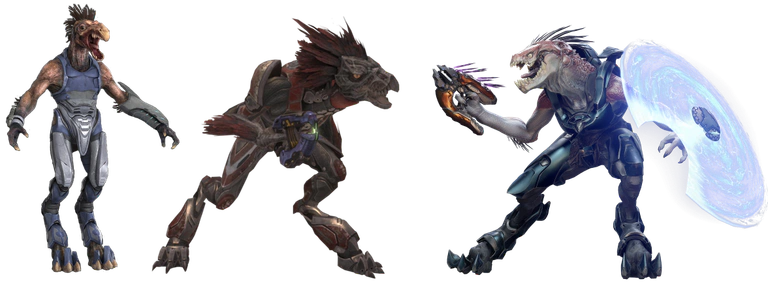
Kig-Yar point defense gauntlet
Point Defense Gauntlets, also known as Jackal Shield Units, are arm-held energy…

Summary
Worn on the forearm of the user, the gauntlet creates a plasma barrier contained within a magnetic field, much like the Sangheili energy sword. This shield deflects and absorbs small arms weaponry to an extent; UNSC ballistic weapons and the Needler simply bounce off the plasma barrier, whereas the Covenant's plasma-based weaponry is absorbed by the plasma barrier, eventually collapsing it.
Heavier weaponry, such as the Fuel Rod Gun, M19/M41 rocket launchers, and the gauss cannon, are considerably effective against the gauntlet's plasma barrier. Alternatively, explosions and extreme force from grenades and melee attacks will collapse the plasma barrier and likely kill the wearer in the process. The shield has a small open section on one side allowing the use of small arms. This opening, however, creates a disadvantage for the user as it exposes said weapon and any body parts behind it to enemy fire.
The shield of the point defense gauntlet reflects its current charge by changing color gradually from its original color to red before it deactivates completely.
There are several models of point defense gauntlets. The most common one is mounted on a wrist strap with an oval emitter, and has two cutaways for firing. A newer, more advanced model was first seen during the Battle of Reach, which had only one cutaway and was emitted by a full-arm gauntlet. A third variant has been seen in use by T'vaoan Murmillos.
Changes from Halo: Combat Evolved to Halo 2
• Shields now slowly turn a red color as they take more damage.
• Jackal Majors are indicated by an orange shield and orange armor, rather than brownish skin.
• The gaps for firing weapons are slightly smaller.
Changes from Halo 2 to Halo 3 and Halo 3: ODST
Kig-Yar Majors are indicated by a purple-blue color in their shield, rather than orange.
Unlike the first two games, the gauntlet protects against melee attacks. A melee collapses the shield on lower difficulties with one hit, while it takes a couple on Legendary (melee weaponry such as the Energy Sword will cut through it instantly, regardless of the difficulty).
Shields will recharge significantly faster than in the first two games.
Small gap for the firing weapon is slightly larger and can more easily be exploited by the player.
Changes from Halo 3 and Halo 3: ODST to Halo: Reach
There is now only one cutaway for return-fire as opposed to two in previous games.
The shield is now more rounded and much larger, making it harder for the player to get around it.
Jackals now wield the shield with their left arm and fire with the right hand.
High-ranked Skirmishers also use a variant of the shield gauntlet on each forearm.
The shield now floats in front of the gauntlet, as opposed to being attached to a circular emitter.
Kig-Yar Majors now have red shields rather than purple.
Changes from Halo: Reach to Halo 4
• The more durable shields are orange instead of red.
• The shield now illuminates the ground and the surrounding area.
Sources
Adapted from the original article, under CC BY-SA 3.0.